Credit Score Basics: What Your Number Means and How to Raise It

A credit score is a 3-digit number, usually from 300 to 850, that tells lenders how likely you are to pay back money you borrow.

Disclosure: This post may contain affiliate links. As an Amazon Associate, we earn from qualifying purchases. This comes at no extra cost to you. Read our full disclosure, or see how we review platforms.
A credit score is a 3-digit number, usually from 300 to 850, that tells lenders how likely you are to pay back money you borrow.
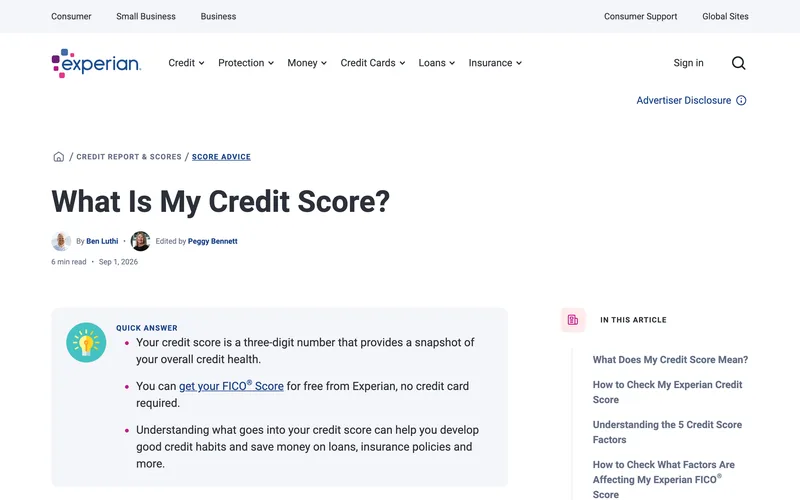
That one number can decide whether you get a loan, an apartment or a lower interest rate.
The good news is that you can see your score for free, and you can change it with steady habits.
This guide explains what the number means, which score counts as good and how the 5 scoring factors are weighted.
You’ll also learn why your score looks different in every app, how to check it safely and how to raise it.
What Is a Credit Score?
A credit score predicts how likely you are to repay a loan on time, based on your credit reports, says the Consumer Financial Protection Bureau. Most credit scores run from 300 to 850, and a higher number means less risk to a lender.
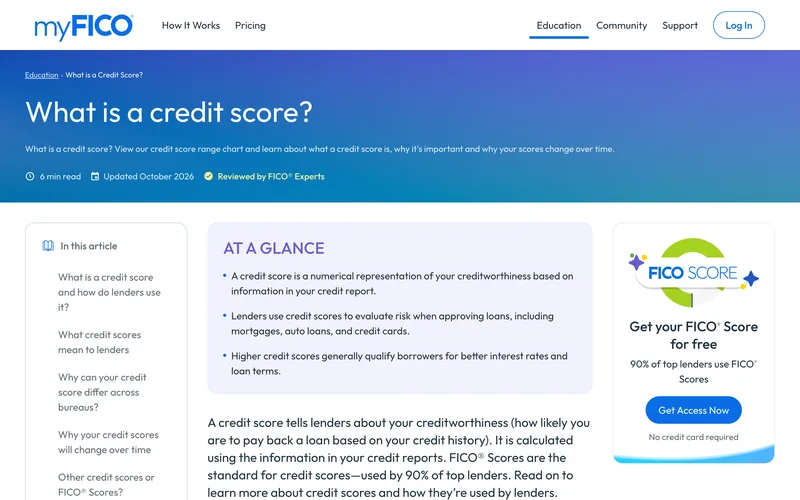
myFICO describes the score as a measure of your creditworthiness, which means how likely you are to pay back what you borrow.
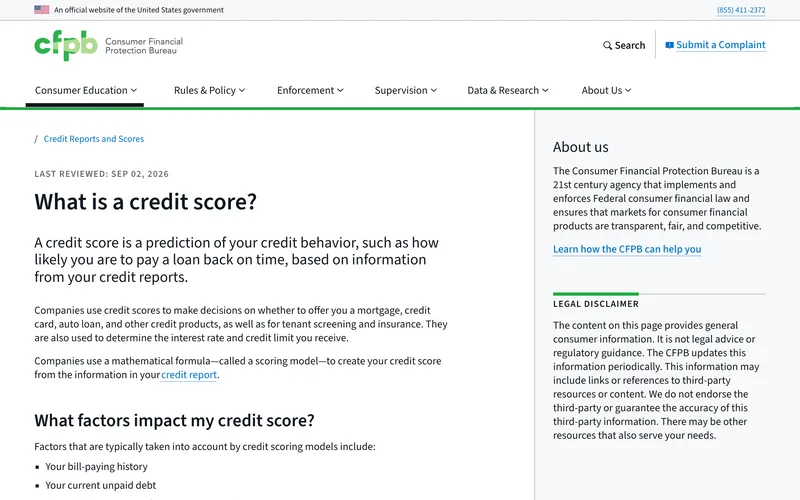
A math formula called a scoring model turns your credit history into that number.
The model looks at the accounts on your report, such as credit cards, auto loans, student loans and mortgages. It also looks at how you have handled each one.
The best-known model is the FICO score, built by Fair Isaac Corporation. Its main rival is VantageScore, a separate model that reads the same kind of report data.
Both models pull their data from the three nationwide credit bureaus: Experian, Equifax and TransUnion. These companies collect what your creditors and lenders report about you.
In other words, your credit score is a short summary of your borrowing record that lenders use to judge your credit risk.
Credit Score vs Credit Report: What’s the Difference?
A credit report is the full record of your accounts, balances, payments and credit inquiries. A credit score is one number calculated from that record.
You have a separate report at each of the 3 credit bureaus.

Your report lists details such as open and closed accounts, card balances, loan balances, your payment history and any accounts sent to collection. It also shows public records such as a bankruptcy or a foreclosure.
A lender or app runs a scoring model on that record of your credit behavior to get your score. The same report can give different scores under different models.
Why does that matter for you?
When your score changes, the reason is a change in the information on your report. The report is where you look for mistakes, and the score is how you track whether things are getting better.
What Are the Credit Score Ranges?
FICO credit score ranges run from Poor below 580 to Exceptional at 800 and above, on a scale that tops out at 850. The base FICO Score 8, the score most widely used by lenders, follows these 5 ranges:
- Poor (300 to 579): well below the US average, and lenders may see you as a risk.
- Fair (580 to 669): below average, though many lenders will still approve a loan.
- Good (670 to 739): near or slightly above average, and most lenders call this good.
- Very Good (740 to 799): above average, and lenders see you as a dependable borrower.
- Exceptional (800 to 850): well above average, marking a very low-risk borrower who can get the best terms.
Lower scores usually mean fewer loan choices and higher interest rates. Good and Very Good scores tend to qualify for competitive rates.
If your score is around 550, a score that low sits in the Poor range, but it can climb with on-time payments. Any score of 800 or more counts as Exceptional, so the step from 800 to a perfect 850 matters less than most people think.
Knowing your range matters more than the exact number, since lenders read scores by range.
What Is a Good Credit Score?
A good credit score is 670 to 739 on the FICO scale, according to myFICO, the site run by FICO itself. A score of 740 or more is Very Good, and 800 or more is Exceptional.
Here’s the deal:
There is no single minimum credit score that all lenders require. Each lender sets its own cutoff based on the loan type, its own risk rules and your income and debt.
That means a 680 might be enough for one card and too low for another. Before you apply, look up the score you need for a card or the score lenders want for personal loans.
The same goes for big purchases. The score you need for buying a car can be different from what a landlord wants when you are renting an apartment.
A good score opens most doors, but always check the specific lender’s rules before you apply.
How Is a Credit Score Calculated?
A FICO credit score is calculated from 5 factors in your credit report. Payment history counts for 35%, amounts owed 30%, length of credit history 15%, new credit 10% and credit mix 10%.
Experian, one of the three credit bureaus, notes that these weights are a guide, and the real math can shift from person to person.

Those percentages show you where to spend your effort. The first 2 factors make up 65% of the score, so they move the number the most.
Payment History (35%)
Payment history tracks whether you pay your bills on time, and it is the biggest single part of your credit score. Experian warns that missing just one payment by 30 days or more could have a significant negative impact on your score.
The longer a bill stays unpaid, the more damage it does. Bigger events hurt even more, such as a loan default, a charge-off, a repossession, a foreclosure, collection accounts or a bankruptcy.
Amounts Owed (30%)
Amounts owed looks at how much debt you carry, and the key number is your credit utilization. Utilization is the share of your available revolving credit, such as your credit cards, that you are using right now.

The model also checks your total debt and the balance on each account. It looks at how much you still owe on installment loans compared with the original amount, and how many accounts carry a balance.
The best part?
You can lower this number by paying your balances down. If you’re carrying several balances, a plan for paying off debt helps both your budget and your score.
Length of Credit History (15%)
Length of credit history measures how long you have used credit. FICO looks at the age of your oldest account, your newest account and the average age of all of them.
A longer record of good habits gives lenders more proof that you pay on time.
The model also looks at how long specific accounts have been open. Time is the one part of this factor you cannot speed up, which is why starting early helps.
New Credit (10%)
New credit covers recent applications and newly opened accounts. Each time you apply, the lender usually runs a hard inquiry on one or more of your credit reports.
The model also checks how long it has been since you opened a new account. Applying only when you need credit keeps this part of your score steady.
Credit Mix (10%)
Credit mix rewards you for handling different kinds of credit, such as credit cards, auto loans and mortgages. Experian says this factor likely won’t decide an approval on its own.
You don’t need to open a loan just to improve your mix. New accounts tend to come naturally as you finance bigger things, such as a car or a home.
In other words, on-time payments and low card balances drive about two thirds of your score, so start there.
FICO vs VantageScore: Which One Do Lenders Use?
FICO is the credit score most lenders use, and myFICO reports that 90% of top lenders use FICO Scores. VantageScore is a competing model, and most scores from either company run from 300 to 850.
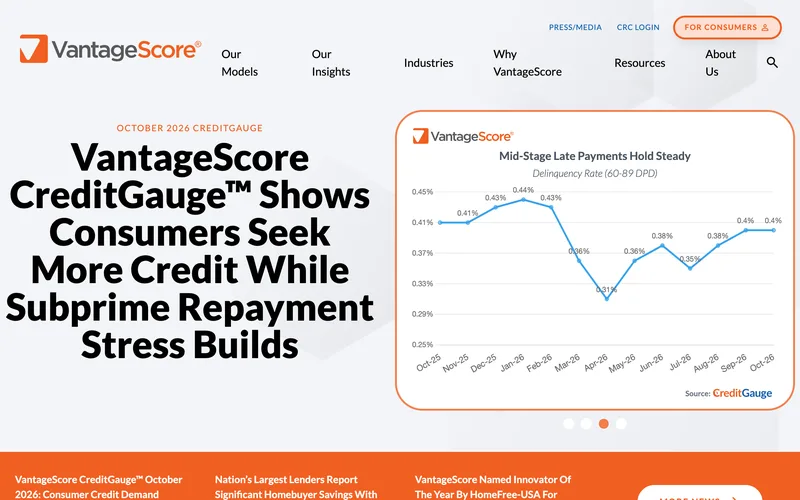
Both models read the same kinds of data from your credit reports. They weigh that data in their own ways, so the two numbers rarely match exactly.
What does that mean for you?
A free app might show one number while a lender sees another. myFICO also points out that not every credit score sold online is a FICO Score.
If you’re planning a big loan, such as a mortgage, check a FICO Score before you apply. Comparing your TransUnion score versus your FICO can explain a gap you might see between apps.
Use any free score to track your trend, but check a FICO Score before you apply for a big loan.
Why Is Your Credit Score Different on Each App?
Your credit score is different on each app because each one may use a different credit bureau, scoring model, model version or update date. The CFPB puts it plainly: you do not have just one credit score, and a score can even change with the day it was calculated.

myFICO lists 4 reasons the numbers differ across bureaus:
- Not every lender reports to all three bureaus, so each bureau may hold different data.
- Lenders report on different dates, so one bureau may show a newer balance than another.
- Different models and versions weigh the same factors in different ways.
- An error or a hard inquiry may show up on one report but not the others.
A gap of a few points between apps is normal. A large gap is a sign to pull your reports and look for a mistake.
If you want to know which bureau’s score matters more, the honest answer is the one your lender pulls.
Why Does Your Credit Score Matter?

Your credit score matters because companies use it to decide on your mortgage, credit card or auto loan. The CFPB says it is also used for tenant screening and insurance.
The same number helps set the interest rate and the credit limit you get. A higher score usually makes it easier to qualify.
A higher score can also lead to a better interest rate or better loan terms, which lowers what you pay to borrow. myFICO adds that higher scores can result in higher credit limits, which gives you more room on your cards.
A low score works the other way. It can mean fewer loan choices and a higher interest rate on the credit you do get.
Landlords may use it for tenant screening when you apply for an apartment. Insurance companies may use it as well.
You can read more about the benefits of good credit to see what a higher score can do for you over time. Your score also works best alongside other personal finance basics, such as a monthly budget.

A higher score can lower what you pay to borrow, from a car loan to a credit card.
How to Check Your Credit Score for Free
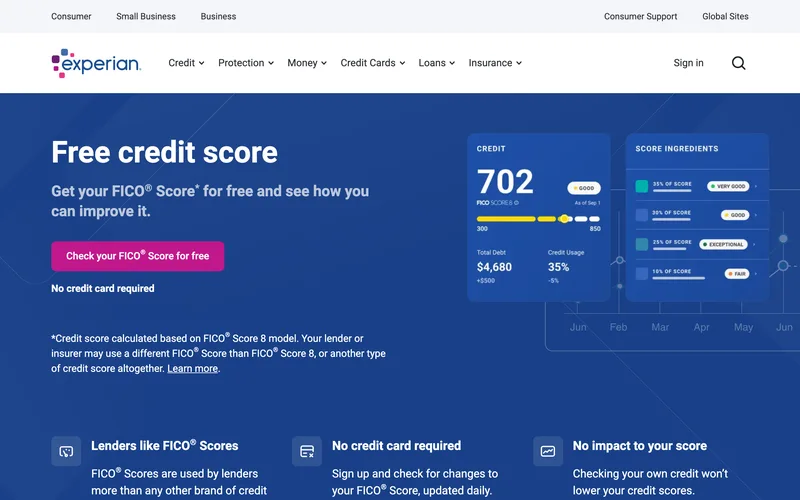
You can check your credit score for free with Experian’s free FICO Score, which shows your FICO Score 8 with no credit card required. The score is based on your Experian credit report.
Experian’s sign-up takes 4 steps:
- Visit Experian’s website, choose the free FICO Score option and enter the last 4 digits of your Social Security number and your phone number.
- Click the link Experian sends by text, then confirm your name, date of birth, full Social Security number and address.
- Create a login with your email address and a password.
- Open your dashboard, where your FICO Score 8 appears, and click it to see the factors behind it.
You can also download the Experian mobile app and sign up there instead of in a web browser.
The free account includes your Experian credit report and free credit monitoring alerts when something changes. A paid plan adds scores from all three bureaus, plus extras like identity theft insurance, which can help before a mortgage.
There are other free ways to check your score as well, each with its own bureau and model.
How to See What Is Hurting Your Score
Experian’s free account rates you on each of the 5 FICO factors in a section called Score Ingredients. To find it, click or tap your FICO Score or the Credit menu, then scroll down.
You’ll see a rating for each factor, and you can open each one to get more details about how you’re doing. That view shows which factor is pulling your score down, so you know where to start.
Does Checking Your Credit Score Lower It?
Checking your own credit score does not lower it, and Experian states that checking your own credit won’t lower your scores. Looking at your own score is not an application for credit.

A hard inquiry is different, because it happens when you apply for new credit and a lender checks your reports. Hard inquiries count toward the new credit factor.
You can look at your own score as often as you like. The deeper look at soft and hard inquiries shows exactly which actions trigger each kind.
Why Does Your Credit Score Go Up or Down?
Your credit score goes up or down because the information in your credit report changes. Each new score uses what the report shows that day.
myFICO notes that your score from a month ago is probably not the same one a lender would get today.
Common reasons for a change include a new payment, on time or late, and a higher or lower card balance. A new credit inquiry and older accounts can move it too.
Experian says scores can go up and down in the short term. Tracking the trend over time shows how well you’re doing with your goals.
Why can one payment move your score?
On-time payments can raise your score, while a payment 30 or more days late can lower it. Your utilization changes too, and a high balance compared with your limits can pull the score down.
Watch the trend over several months instead of reacting to one small drop.
How to Improve Your Credit Score
You improve your credit score mostly by paying every bill on time and keeping card balances low. Those 2 factors make up 65% of a FICO score.
After that, apply for new credit only when you need it and check your reports for errors.
Here’s the order to follow:
- Set up automatic payments for at least the minimum on every card and loan, so no payment ends up 30 days late.
- Pay down card balances to lower your credit utilization, starting with the cards closest to their limits.
- Space out new applications so hard inquiries do not pile up in a few months.
- Keep older accounts in good standing, since the age of your oldest account counts.
- Check your credit reports for wrong late payments or balances that are not yours.
If you find a mistake, Experian says you can file a dispute with the credit bureaus or contact the company that reported it. Old collection accounts are worth a close look, since they hurt your payment history.

Starting with no credit at all? The steps to build credit from scratch are a little different, since you need an account to report first.
For a longer list, see these ways to raise your score with more detail on each step.
Key Takeaways
- It's a risk number. A credit score predicts how likely you are to repay, on a scale that usually runs from 300 to 850.
- Good starts at 670. FICO calls 670 to 739 good, but each lender sets its own minimum.
- Two factors lead. Payment history and amounts owed make up 65% of a FICO score.
- You have many scores. Bureaus, models and dates all change the number you see.
- Checking is free and safe. Checking your own score never lowers it.
Frequently Asked Questions
How can I check my actual credit score for free?
You can check a real FICO Score 8 for free through Experian, with no credit card required. The free account also includes your Experian credit report and alerts when it changes.
Where does a 600 credit score rank?
A 600 credit score sits in the Fair range of 580 to 669 on the FICO scale. myFICO says many lenders still approve loans in that range, though the rates are usually higher.
What is the average credit score?
The average US credit score sits close to the Good range. myFICO describes a score of 670 to 739 as near or slightly above the average of US consumers.
Is a 900 credit score possible?
A 900 credit score is not possible on the base FICO Score 8, which tops out at 850. Experian notes that some industry-specific FICO scores exist, so ask a lender which version it uses.
How do I get a 700 credit score in 30 days?
No one can promise a 700 credit score in 30 days, because your score only moves when your credit report changes. Paying card balances down and making every payment on time are the changes most likely to help.
What credit score do I need for a mortgage?
No single credit score gets you a mortgage, because each lender sets its own minimum by loan type. Lenders also weigh your income, employment history and debt-to-income ratio, and a higher score improves your odds and your interest rate.
The Bottom Line
Your credit score is a 3-digit summary of how you handle debt, and you can see yours for free today.
Pull your free FICO Score this week, write down the number and the factor hurting it most, then fix that one factor first.

Jason is a personal finance expert and the founder of Frugal For Less. He has spent over a decade researching and testing hundreds of money making apps, survey sites, and savings strategies to help readers earn more and keep more of their hard-earned cash.
More about the author