4 Ways to Pay Off Your Mortgage Early (and When to Invest Instead)

You can pay off your mortgage early without a windfall, and small extra payments can save you tens of thousands of dollars in interest.

Disclosure: This post may contain affiliate links. As an Amazon Associate, we earn from qualifying purchases. This comes at no extra cost to you. Read our full disclosure, or see how we review platforms.
You can pay off your mortgage early without a windfall, and small extra payments can save you tens of thousands of dollars in interest.
An extra $300 a month can take more than 11 years off a mortgage.
On a $200,000, 30-year loan at 6%, it also saves about $101,000 in interest, by our math.
Below are 4 ways to pay off your mortgage early, from the easiest to the ones that need real cash. You’ll also see when investing makes more sense.
- Tight budget and paid every other week? Start with #1.
- An extra $150 or more each month goes to work in #2.
- A $10,000 bonus just landed, so #3 fits.
- #4 suits a steady, higher income.
4 Ways to Pay Off Your Mortgage Early
You can pay off a mortgage faster with biweekly payments, extra principal, a recast or a 15-year refinance. The first 2 need no lump sum, so most people should start there.
The 4 ways at a glance
| # | Way | Cost to start | Payoff | Time |
|---|---|---|---|---|
| 1 | Biweekly payments | No bigger payments, or a small fee | $85,000+ saved on a $350,000 loan | 2-4 weeks |
| 2 | Extra principal | From $150 a month | $101,106 saved on a $200,000 loan | Same day |
| 3 | Recast | $10,000+ and a fee | Lower monthly payment | 1-3 months |
| 4 | 15-year refinance | Closing costs | About $175,000 less interest | 1-3 months |
Start with #1 or #2, then add #3 when a lump sum shows up.
1. Switch to Biweekly Payments
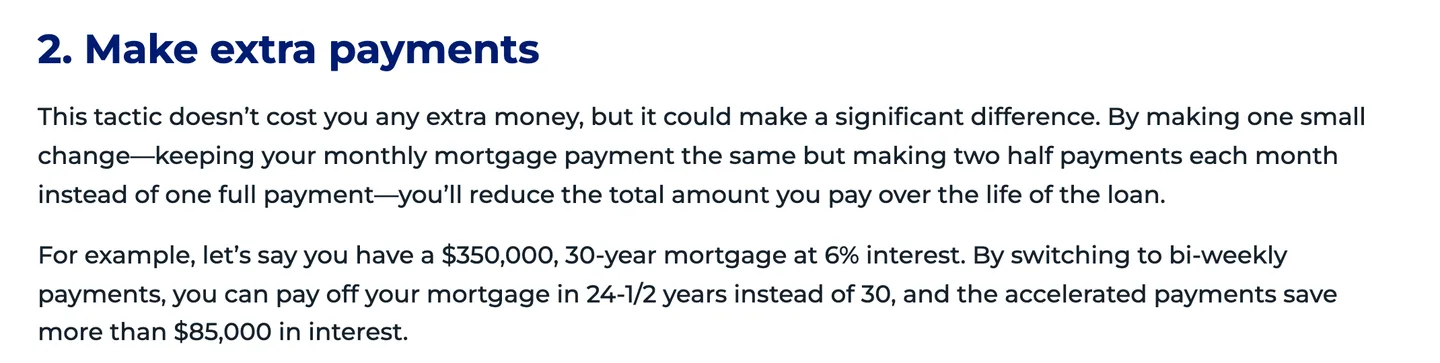
Biweekly mortgage payments mean paying half your monthly payment every 2 weeks, which adds up to 1 extra full payment per year, according to U.S. Bank.
Here’s why: a year has 26 two-week periods, so 26 half payments equal 13 full payments instead of 12.
Global Credit Union’s example shows what that does. A $350,000, 30-year loan at 6% is paid off in 24.5 years instead of 30, and the switch saves more than $85,000 in interest.
The best part? Each payment is half your usual one, so the switch fits a budget that gets paid every other week.
Not every lender offers it, but U.S. Bank notes that third-party services can set it up for a small upfront fee. Ask your lender first, since a fee cuts into the savings.
Here’s what to ask your lender:
Hi, I’d like to switch my mortgage to biweekly payments. Do you offer that, is there a fee, and will the extra payment go to principal?
2. Add Extra to Your Principal Each Month
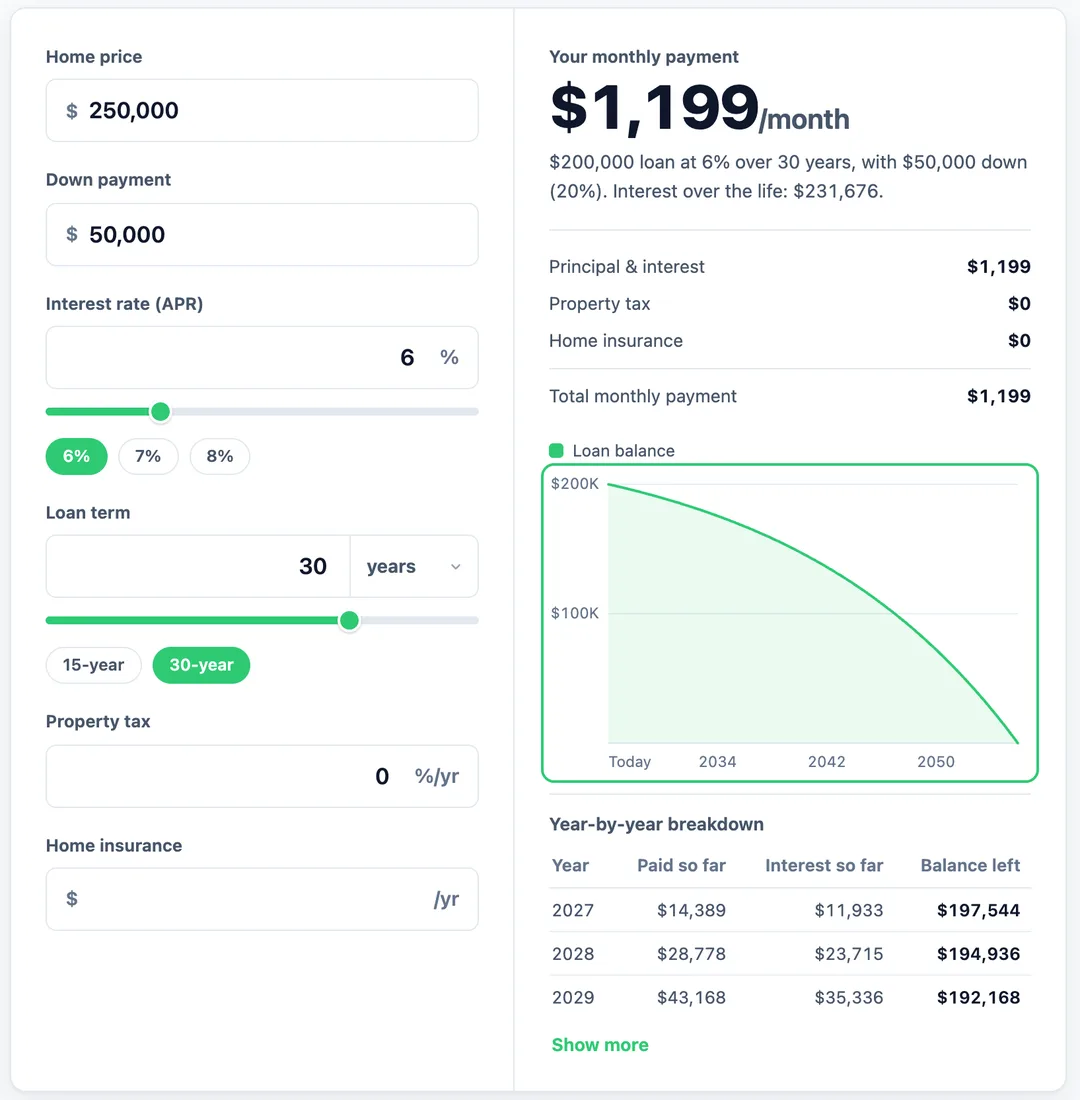
Adding extra to your principal each month shortens your mortgage and cuts the interest you pay. This mortgage payment calculator shows a $200,000, 30-year loan at 6% costs $1,199 a month and $231,676 in interest over its life.
Add $300 a month, and by our math the loan is paid off in 18 years and 5 months instead of 30. That saves $101,106 in interest.
Smaller amounts help, too. In Global Credit Union’s example, $150 extra a month pays off a $350,000 mortgage at 6% with 18 years left 2 full years sooner.
Before you start, ask your lender to make sure the extra goes to principal, not to interest, as Global Credit Union advises. Here’s how to set it up:
- Pick an amount you can keep paying. Cutting everyday money wasters or taking one of these best second jobs can fund it.
- Mark the extra as principal. That way it lowers your balance.
- Automate it. Set it to go out with every payment.
Pay off credit cards first if you have them. U.S. Bank says paying off high-interest card debt is often the smarter move.
3. Recast After a Lump Sum
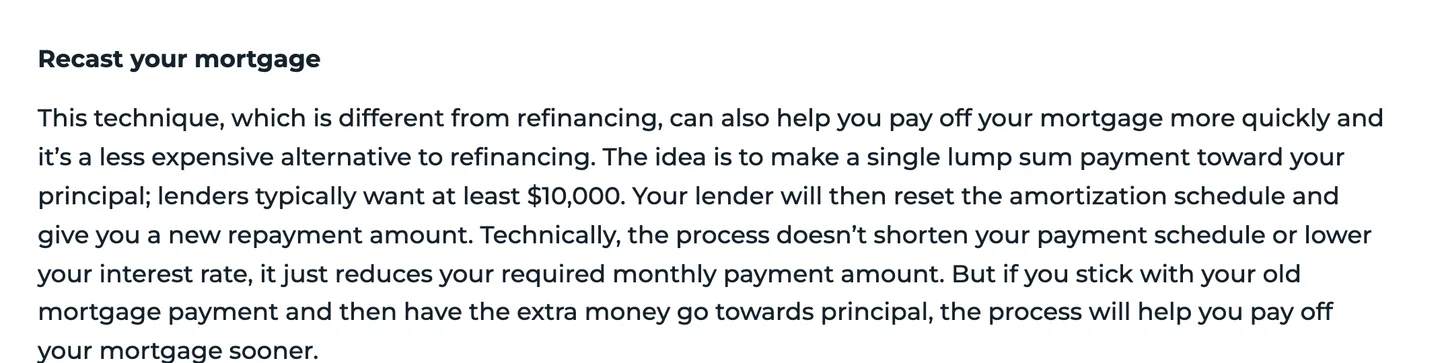
A mortgage recast is one large payment toward your principal, and lenders typically want at least $10,000, says Global Credit Union. Your lender then resets the payment schedule and lowers your monthly payment, at the same interest rate.
Not all lenders offer recasting, and there’s usually a fee. It can still cost less than a refinance, especially if you have a low rate you want to keep.
The catch? A recast doesn’t shorten the loan by itself.
Keep paying your old amount after the recast, and the difference goes to principal, which pays the loan off sooner. Saving up for it? These ways to save $20,000 in a year can help.
Use a bonus, inheritance or tax refund for a recast, never your emergency fund.
Ask your lender these questions first:
Hi, do you offer mortgage recasting on my loan? What’s the minimum lump sum, what’s the fee, and how long does it take?
4. Refinance to a 15-Year Loan
Refinancing from a 30-year to a 15-year mortgage pays your home off faster, but it raises your payment and adds closing costs. Global Credit Union says to count those costs and make sure the breakeven point makes sense for you.
Rates matter most here. Freddie Mac’s weekly survey put the average 30-year rate at 7.24% and the 15-year rate at 6.60% as of October 29, 2026.
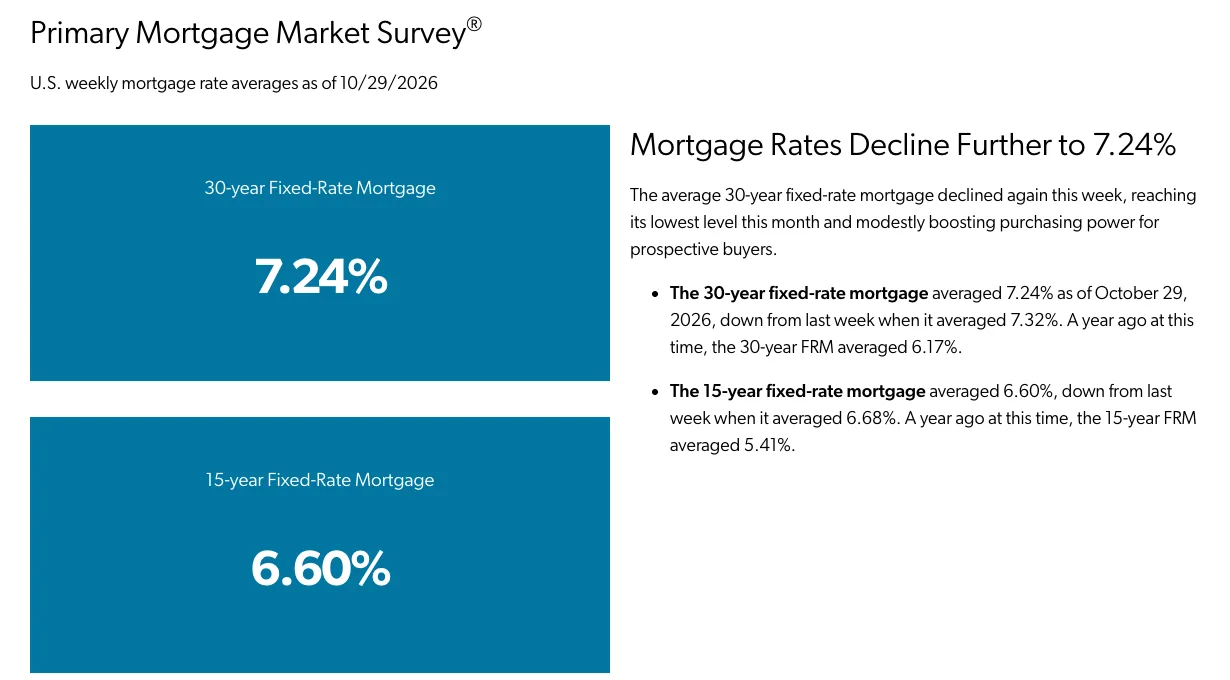
Here’s the deal: on a $200,000 balance at those averages, a 15-year loan costs about $1,753 a month, and a 30-year costs about $1,363. That’s about $390 more each month, but about $175,000 less in total interest, by our math.
If your current rate is lower than today’s 15-year average, a refinance would raise your rate. In that case, extra principal (#2) is the better route.
Before you sign, check 3 things:
- The new rate is lower than your current one.
- You’ll stay in the home past the breakeven point.
- The higher payment still leaves room to save.
Only refinance if all 3 are true. Get quotes from at least 2 lenders, fees included, so you can compare.
Long Shots Worth Knowing About
Two bigger moves can clear a mortgage even faster, but each one changes how you live.
Downsize. A smaller, cheaper home can shrink the mortgage or clear it, and Global Credit Union notes that utility and insurance bills drop, too. The downside: you have to move.
If you’d go much smaller, check whether living in a tiny house really saves money.
Rent out rooms. Tenants can cover part of your payment, and you can send their rent straight to principal. The downside: you share your home.
I paid off my first mortgage in a few years by renting out rooms. By the time I moved, the rent I’d collected was more than double what I paid for the home.
Here’s a simple example: say you owe $100,000 at 4.5% with 20 years left, and you pay about $633 a month. Then you add $500 a month of room rent to each payment.
That pays the loan off in about 9 years instead of 20. Short-term guests on Airbnb can pay more per night, but they mean more cleaning and more messages.
Screen every renter, sign a written lease, and check your mortgage terms and your city’s rental rules before you list. Renting a room is also one of the ways to create passive income from what you already own.
Should You Pay Off Your Mortgage Early or Invest?
Pay off your mortgage early if you have a full emergency fund, a fairly high interest rate and no costlier debt, says U.S. Bank. If your rate is low, investing the extra cash has the potential to build wealth faster.
U.S. Bank sums it up in a side-by-side table. Each row shows when paying off early wins and when investing does.
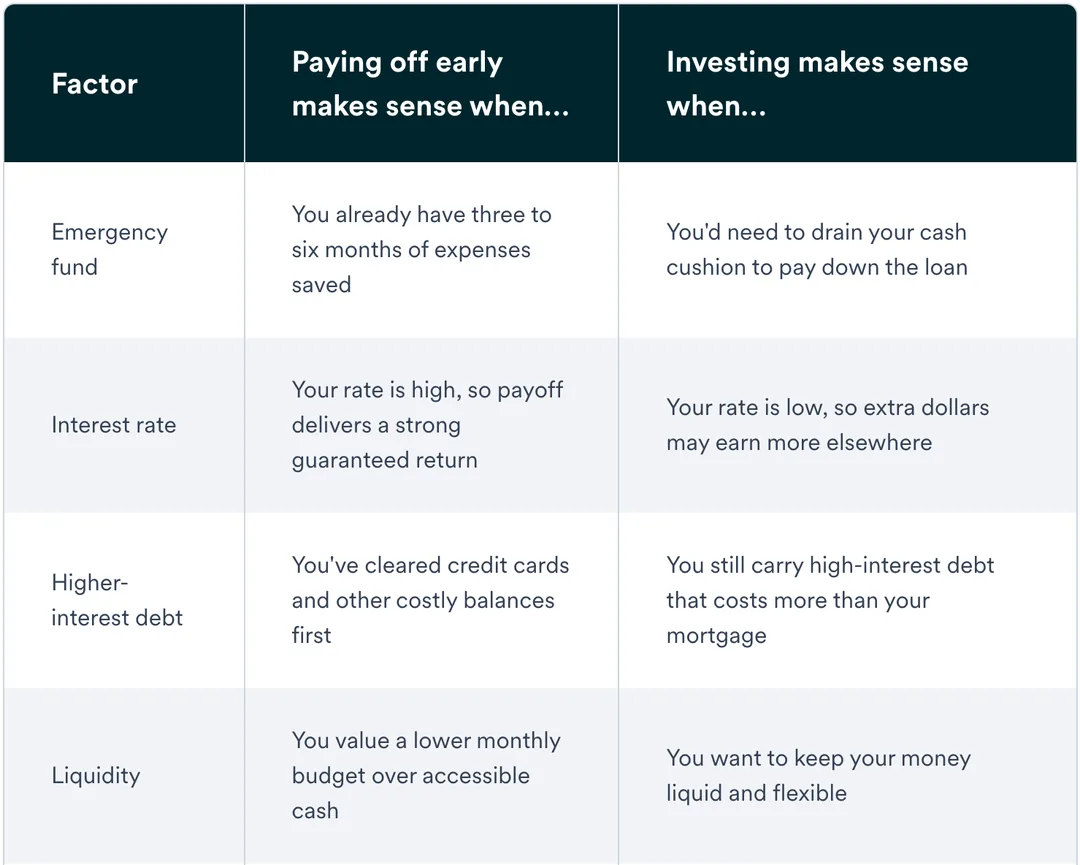
Build your cushion first. “It’s crucial to make sure you have an emergency fund set up before you consider something like paying off your mortgage,” says Ryan Peters of U.S. Bank.
He recommends 3 to 6 months of expenses in that emergency fund. He also suggests putting enough into your workplace retirement plan to get any employer match before you send extra cash to the mortgage.
With a low rate, look at tax-advantaged accounts like a 401(k) or an IRA, or start by investing your first $500. Paying off the loan also ends the mortgage interest deduction, which matters only if you itemize.
Heard that everyone should pay off the house first? Dave Ramsey’s advice doesn’t fit every budget.
How to Start This Week
A payoff plan only works if you keep doing it, so start with a step you can repeat. This week, ask your lender whether your loan has a prepayment penalty and whether it offers biweekly payments.
Then set up your first extra principal payment, even a small one. Check your statement the next month to make sure it went to principal.
Key Takeaways
- Biweekly is the easy start. Half payments every 2 weeks add 1 extra payment a year without raising any single payment.
- Small extras add up. $300 a month on a $200,000 loan at 6% saves $101,106 in interest.
- A recast lowers your payment. Keep paying the old amount if you want to finish sooner.
- Refinance only for a lower rate. A 15-year loan saves interest but raises the monthly payment.
- Emergency fund first. Keep 3 to 6 months of expenses saved before you pay extra.
Frequently Asked Questions
Can you pay off a mortgage early without a prepayment penalty?
Yes, as long as your loan doesn’t include one, so check your loan papers or ask your lender first. U.S. Bank notes that prepayment penalties are usually worked in when the mortgage closes.
Does paying off a mortgage early hurt your credit score?
It can cause a small dip, because it lowers your credit mix and the average age of your accounts, says U.S. Bank. For most people, the effect is small and temporary.
How much faster do biweekly payments pay off a mortgage?
In Global Credit Union’s example, biweekly payments pay off a $350,000, 30-year loan at 6% in 24.5 years instead of 30. That’s because 26 half payments a year add up to 13 full payments.
Should you pay off your mortgage before you retire?
Often, yes, says U.S. Bank, because it eases cash flow once your paycheck stops. Don’t drain the accounts you’ll live on or need for healthcare.
What happens after you pay off your mortgage?
You stop paying interest, but you lose the mortgage interest deduction, so Global Credit Union says you may pay more income tax. That only matters if you itemize your deductions.
The Bottom Line
Start with biweekly payments or a small extra principal payment, since neither one needs a lump sum. Add a recast when a bonus shows up, and refinance only if you can get a lower rate.
Keep your emergency fund full first, and browse our other money management guides to plan the rest of your budget.

Jason is a personal finance expert and the founder of Frugal For Less. He has spent over a decade researching and testing hundreds of money making apps, survey sites, and savings strategies to help readers earn more and keep more of their hard-earned cash.
More about the author